Studio Journal · November 3, 2026
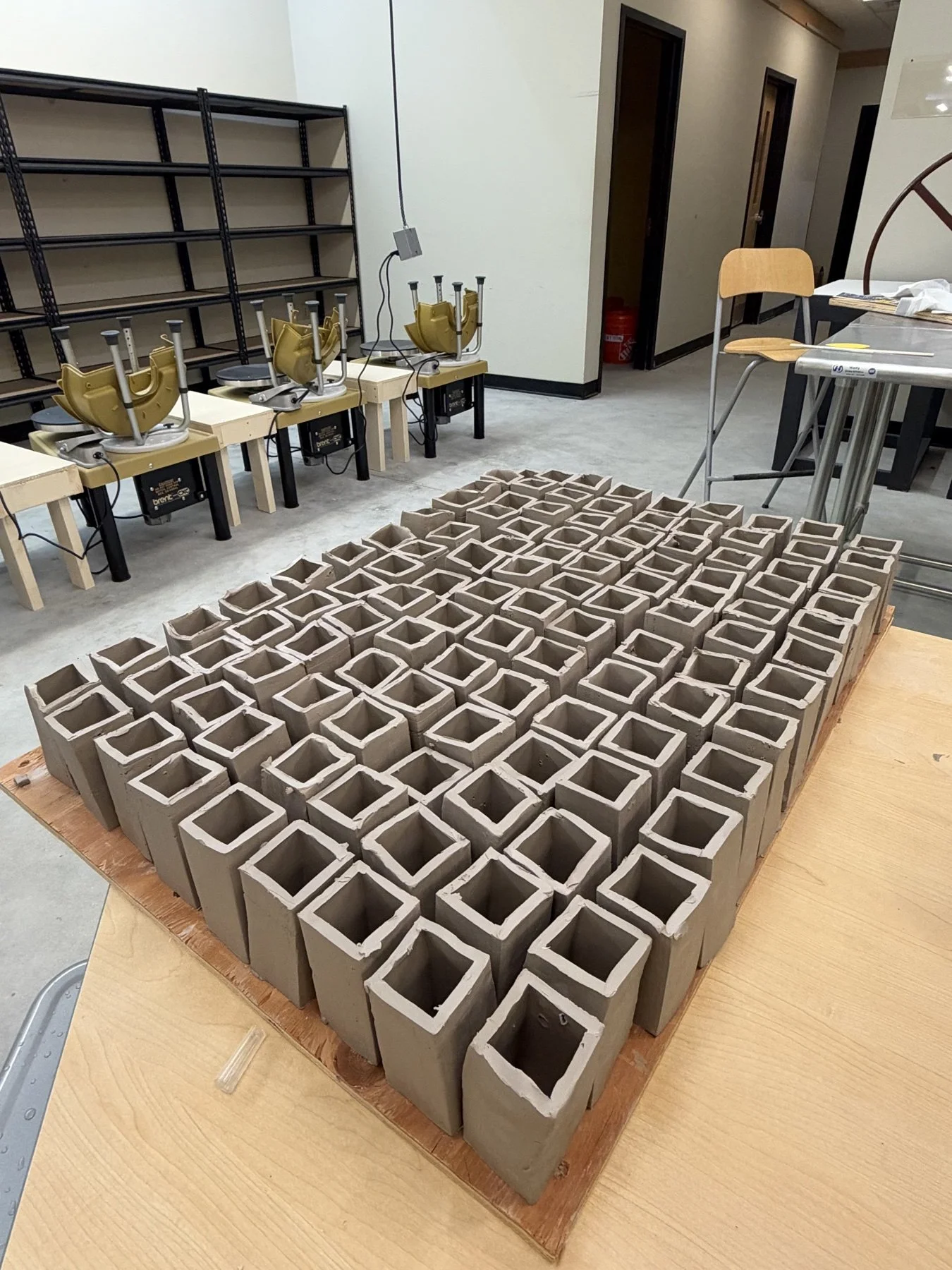
Building the glaze wall starts with testing every glaze under Firebox conditions.
One of the bigger decisions I've had to make is: what does our glaze wall look like? After form, glazes occupy a central role in artistic expression.
To me, there are several variables that go into selecting a glaze: opacity, color, texture, reactivity, character. In my own work, I want to create with intention — I want to go to a glaze wall and make a reasonably predictable decision around what the final aesthetic after firing might look like, while still allowing kiln magic to happen. And when building a glaze wall, each glaze has to earn its place. Spots are limited, the selection set is large, and I don't want one material providing redundant properties that another already does.
A glaze wall looks like a collection of colors. It isn't. It's a technical reference. Each tile records what actually happened when a specific glaze met a specific clay body at a specific thickness in a specific firing. The same glaze can read bright on white stoneware, muted on brown, glossy where it pools, and nearly another color where it breaks over an edge. None of that is predictable from a manufacturer's photo.
Firebox also maintains an underglaze selection — underglazes brushed on under a clear coat are predictable, forgiving, and good for color work and surface decoration. They do a lot. But they don't do everything. Underglazes can't break over an edge, pool in a recess, shift with kiln atmosphere, or respond to thickness the way a glaze can. The dip glaze wall exists specifically to open up the range of surfaces that underglazes alone don't make possible — the material voice of the clay and the kiln, not just applied color.
Once the glazes have been selected, there are three phases to the execution:
- Phase I: In a startup environment, you need to see a glaze palette as your work progresses and you think about what your pieces should look like. When opening a studio from scratch, that means we need to offer a tested selection of glazes fast.
- Phase II: Custom formulations with raw materials — approximating existing glazes and filling in the gaps.
- Phase III: Reliably offering formulations in small batches to members — think reproducing glazes from Glazy or Digitalfire.
For now, Phase I means we're starting with commercial glazes. We wanted enough range to support exploration and teaching without presenting an unstructured wall of choices. We're beginning with commercially prepared glazes from Amherst Potters Supply and Coyote Clay & Color, then testing and documenting them under Firebox conditions. There's also an element of de-risking here: our clay bodies are formulated by Amherst Potters Supply, and the glazes developed there are validated on these very clay bodies.
These are the opening framework, not the final identity of the studio's glaze program. And not all of them may make it to the wall — we're testing every glaze on this list, but a glaze that doesn't perform reliably under Firebox conditions won't be released just because we bought it.
The Foundation
The most frequently used glazes in a shared studio are the least dramatic ones. Clears and liners make underglaze decoration possible. Neutrals let form and texture stay visible. Darks provide contrast and reliable interiors.
The opening foundation:
- APS Clear
- APS White Matt
- APS Adrienne's Black
- APS Tenmoku
- Coyote Creamy Matt
- Coyote Gloss White Liner
Between them, these cover the basics: transparent, opaque, glossy, matte, light, dark. They work on their own, and once testing is done, some will become useful bases for layering.
Color and Surface Character
A glaze library should also show what happens when a surface responds visibly to thickness, texture, and heatwork.
The opening color and character glazes:
These weren't selected just for color. Some break over carved or raised surfaces. Some pool differently in recesses. Some produce real variation between thin and thick application. These are the surfaces that underglazes can't give you — they respond to the piece and the firing, not just to the brush. In a teaching studio, that's the point. Students can look at a finished piece and start to understand what the kiln did to it.
The Reactive End of the Wall
We're also introducing three Coyote glazes with more potential for variation:
Reactive glazes can produce compelling surfaces, but they need clearer application guidance than the rest of the wall. A glaze that moves during firing may need additional clearance above the foot. A glaze affected by cooling may look different in separate areas of the same kiln. A thick application may produce depth and variation — or it may create a firing problem.
These three will be released with instructions and restrictions established through our own testing, not from a manufacturer's sample photo.
Why Manufacturer Samples Aren't Enough
Commercial sample tiles are useful as a starting reference. They don't predict what will happen at Firebox.
A fired result changes with the clay body, the thickness of the glaze, the length of the dip, the shape and texture of the piece, where it sat in the kiln, how much heatwork it received, the cooling schedule, and whether another glaze was applied above or below it. That's a lot of variables, and a manufacturer's tile controls for almost none of them under our conditions.
The definitive references at Firebox will be tiles made from our approved clay bodies, glazed from our studio buckets, and fired in our kilns. The first test wall will show every opening glaze on both APS White and APS Brown stoneware — testing the same glaze on a light and a dark body makes the influence of the clay immediately visible. We'll add curated combinations after the individual glazes have been evaluated.
Food-Contact Surfaces
Having a glaze in the studio doesn't mean it's approved for every use.
APS Slopey's Blue and Coyote Sedona Sunset are classified as decorative glazes and may not be used on food-contact surfaces. They can go on sculpture, decorative work, or exterior surfaces that won't contact food or drink.
Our guidance here is that we defer to the manufacturer's advice. It should be noted that a manufacturer's general description doesn't guarantee that every finished pot is food-safe — that also depends on the clay body, application thickness, firing, glaze fit, and the condition of the finished surface.
Follow the designation posted with each Firebox glaze and test tile. A decorative-only glaze doesn't go inside a cup, bowl, plate, serving vessel, or anywhere food or drink will touch it.
From Bucket to Wall
Before an opening glaze becomes a general studio offering, the work goes well beyond mixing it with water.
We're resuspending and sieving each glaze, recording the water additions, establishing a repeatable working consistency, making standardized test forms, applying each glaze at controlled thicknesses, firing the tests on approved Firebox clay bodies, and evaluating the results for color, texture, movement, and glaze fit. We're also recording foot-clearance and application requirements, identifying functional-use restrictions, and labeling and installing the finished tiles.
If a glaze doesn't perform reliably, it gets adjusted, restricted, reformulated, or withheld. A promising first tile is the beginning of evaluation, not the end.
Building a Firebox Glaze Program
Buying commercial glazes is the fastest responsible way to open with a useful range of surfaces. It also lets our students and members start working while the studio develops the deeper technical knowledge needed to maintain an original glaze library.
Over time, we intend to formulate our own glazes and develop in-house alternatives where doing so improves consistency, cost, safety, or creative range. That process will follow a deliberate cycle: formulate, test, evaluate, release. A new formula has to work with our clay bodies, our application methods, our firing schedules, and shared-studio practices before it becomes part of the general library.
The goal isn't to reproduce another studio's wall or assemble the largest possible collection. It's to build a glaze program that is useful, legible, technically informed, and distinctly Firebox.
The opening wall is the first version of that program. The tiles will come out of the kiln sometime this weekend. Next week, these tiles will go up on the glaze wall. I'm excited!