Fall 2026 Classes
Find Your Place In Clay
Learn wheel throwing, handbuilding, sculpture, and surface techniques with working ceramic artists. Firebox offers adult, youth, and family classes for first-time students and experienced makers.
Opening Quarter
Fall 2026 Schedule
Classes meet in Studios A and C at our Belmont studio. Regular open studio access in Studio A runs from 7 a.m.–10 p.m. whenever class is not in session. Select a class to jump to its description.
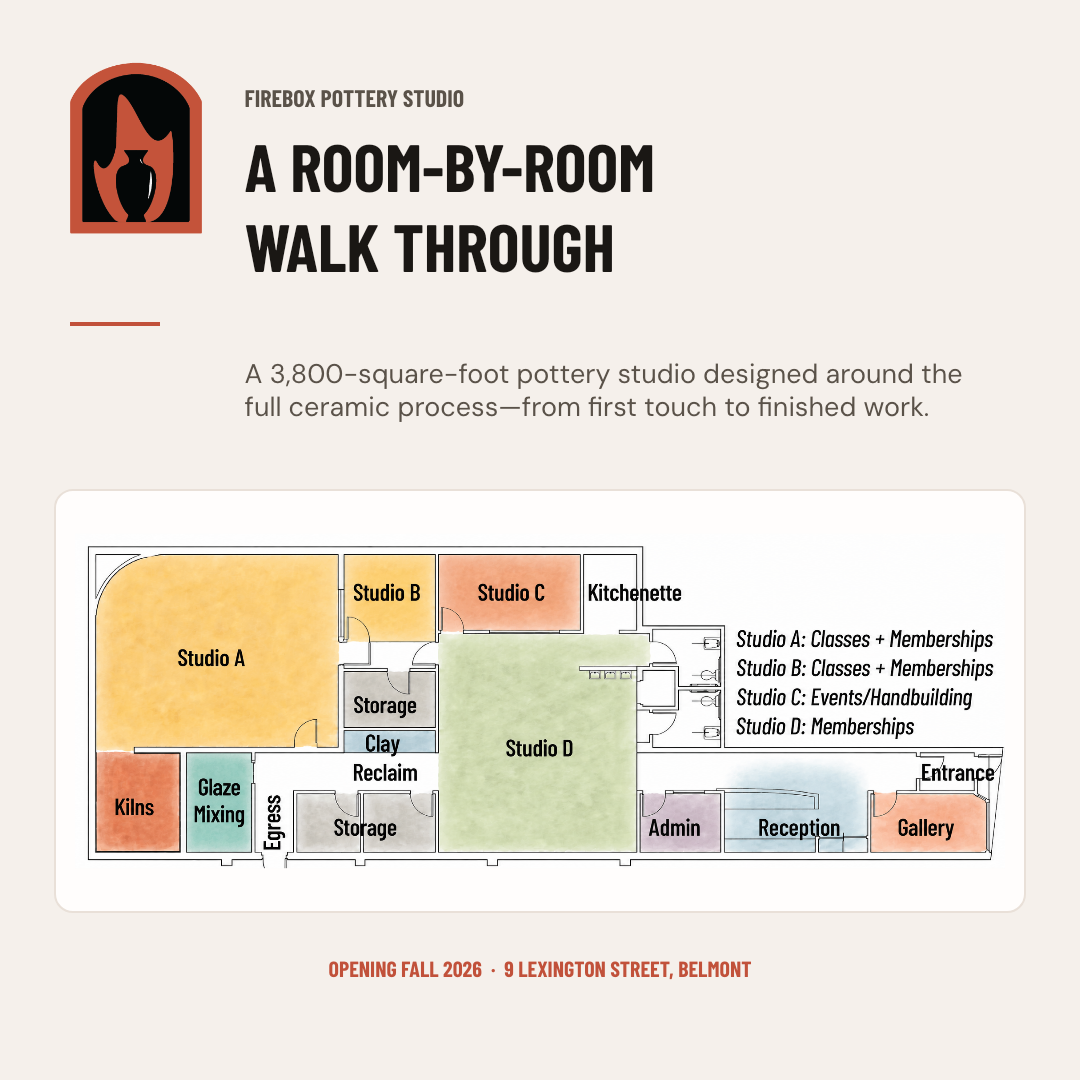
Where Classes Happen
Two Studios. One Creative Community.
Studio A is our primary wheel and adult classroom. Studio C offers an inviting setting for youth, family, community, handbuilding, and sculpture programs.
Studio A
Pale orange shows open studio for members and eligible students; cream shows classes; gray shows events.
The calendar shows regular weekly use of Studio A from 7 a.m.–10 p.m. Class blocks link to course descriptions below.
Studio C
Youth, family, community, handbuilding, and sculpture classes.
Studio C class blocks are positioned by their actual start and end times and link to course descriptions below.
Explore The Catalog
Fall 2026 Courses
Start with who the class is for, then compare techniques, experience levels, and schedules. Studio location is included within each course listing. Additional classes may be added based on demand; we will share new offerings once their schedules and details are finalized.
Adult Classes
Wheel, Handbuilding, Sculpture & Mixed MethodsBeginner–Intermediate Wheel Throwing
This eight-session course welcomes adults who are new to the pottery wheel as well as returning students ready to strengthen their skills. Beginners will build a foundation in wedging, centering, opening, pulling walls, shaping, trimming, and glazing. Students with prior experience will receive individualized guidance as they refine their technique, improve consistency, and work toward more complex forms.
Through demonstrations and hands-on instruction, students will make functional forms such as cups, bowls, cylinders, and vases while learning the complete process from clay preparation through glazing and firing. David will adapt instruction to each student’s experience and goals.
Optional Raku opportunity: Students may also have an opportunity to participate in a Raku firing. This opportunity is not guaranteed or included in tuition at this time. Availability, scheduling, location, eligible materials, safety requirements, and any additional fees will be confirmed separately.
- AudienceAdults
- LevelBeginner–intermediate
- Price$520
- Sessions8 sessions
- DatesOctober 26–December 14, 2026
- ScheduleMondays, 10 a.m.–1 p.m.
- StudioStudio A
- Clay$25 per sealed 25-pound bag; purchased separately
- Firing$60 firing credit included; firing beyond the credit is charged separately
- Tools & materialsBasic tools, standard glazes, pails, sponges, and cleaning supplies provided
Adult Handbuilding: Functional vs Decorative
Learn Handbuilding and sculpture techniques and how they might be conducive to functional or decorative ware. Students will learn slab, coil, and solid building techniques, and how to choose an appropriate technique for a project. We will tackle handbuilt dinnerware, as well as home decor sculpture!
- AudienceAdults
- LevelBeginner-friendly
- Price$455
- Sessions7 sessions
- DatesOctober 26–December 21, 2026
- ScheduleMondays, 1:30–4:30 p.m.
- StudioStudio A
- Clay$25 per sealed 25-pound bag; purchased separately
- Firing$60 firing credit included; firing beyond the credit is charged separately
- Tools & materialsBasic tools, standard glazes, pails, sponges, and cleaning supplies provided
Adult Beginning Wheel: The Big Breakfast – Mugs and Bowls
Never touched clay before? No problem! In this class students will learn the basics of wheel throwing, and how to make mugs and bowls, so you can have your morning cereal and coffee in dinnerware of your own creation!
- AudienceAdults
- LevelBeginner
- Price$455
- Sessions7 sessions
- DatesOctober 27–December 15, 2026; no class November 24
- ScheduleTuesdays, 6–9 p.m.
- StudioStudio A
- Clay$25 per sealed 25-pound bag; purchased separately
- Firing$60 firing credit included; firing beyond the credit is charged separately
- Tools & materialsBasic tools, standard glazes, pails, sponges, and cleaning supplies provided
Beginner–Intermediate Wheel Throwing
This seven-session course welcomes beginning and intermediate adult wheel students. Alejandra will help newer students build core throwing skills while supporting returning students as they strengthen their technique and continue developing their individual practice.
- AudienceAdults
- LevelBeginner–intermediate
- Price$455
- Sessions7 sessions
- DatesOctober 27–December 15, 2026; no class November 24
- ScheduleTuesdays, 10 a.m.–1 p.m.
- StudioStudio A
- Clay$25 per sealed 25-pound bag; purchased separately
- Firing$60 firing credit included; firing beyond the credit is charged separately
- Tools & materialsBasic tools, standard glazes, pails, sponges, and cleaning supplies provided
Intermediate / Advanced Wheel
In this eight-session intermediate/advanced wheel throwing class, each student will work collaboratively with me to assess and define your level of throwing skills and techniques and create an individualized plan for how you wish to grow as a potter. Throughout the course you will receive hands-on demonstrations of technique and individualized support to improve your skills. Students will explore throwing off the hump, taller and bulbous forms, sectional construction, covered jars and lids, surface decoration, glazing techniques, and trimming concepts.
Optional Raku opportunity: Students may also have an opportunity to participate in a Raku firing. This opportunity is not guaranteed or included in tuition at this time. Availability, scheduling, location, eligible materials, safety requirements, and any additional fees will be confirmed separately.
- AudienceAdults
- LevelIntermediate–advanced
- Price$520
- Sessions8 sessions
- DatesOctober 21–December 16, 2026
- ScheduleWednesdays, 6–9 p.m.
- StudioStudio A
- Clay$25 per sealed 25-pound bag; purchased separately
- Firing$60 firing credit included; firing beyond the credit is charged separately
- Tools & materialsBasic tools, standard glazes, pails, sponges, and cleaning supplies provided
Intermediate / Advanced Wheel
In this eight-session intermediate/advanced wheel throwing class, each student will work collaboratively with me to assess and define your level of throwing skills and techniques and create an individualized plan for how you wish to grow as a potter. Throughout the course you will receive hands-on demonstrations of technique and individualized support to improve your skills. Students will explore throwing off the hump, taller and bulbous forms, sectional construction, covered jars and lids, surface decoration, glazing techniques, and trimming concepts.
Optional Raku opportunity: Students may also have an opportunity to participate in a Raku firing. This opportunity is not guaranteed or included in tuition at this time. Availability, scheduling, location, eligible materials, safety requirements, and any additional fees will be confirmed separately.
- AudienceAdults
- LevelIntermediate–advanced
- Price$520
- Sessions8 sessions
- DatesOctober 22–December 17, 2026
- ScheduleThursdays, 10 a.m.–1 p.m.
- StudioStudio A
- Clay$25 per sealed 25-pound bag; purchased separately
- Firing$60 firing credit included; firing beyond the credit is charged separately
- Tools & materialsBasic tools, standard glazes, pails, sponges, and cleaning supplies provided
Wheel Throwing Foundations
This eight-session course builds essential wheel skills through wedging, centering, opening, pulling walls, and shaping mugs, bowls, plates, and vases. Demonstrations and individual instruction carry projects through trimming, surface treatment, glazing, and firing.
- AudienceAdults
- LevelBeginner–advancing beginner
- Price$520
- Sessions8 sessions
- DatesOctober 22–December 17, 2026
- ScheduleThursdays, 6–9 p.m.
- StudioStudio A
- Clay$25 per sealed 25-pound bag; purchased separately
- Firing$60 firing credit included; firing beyond the credit is charged separately
- Tools & materialsBasic tools, standard glazes, pails, sponges, and cleaning supplies provided
Handbuilding Functional Forms
There is a distinct magic in taking a raw slab or coil of clay and turning it into something you use every single day. This six-week course is designed for anyone who wants to slow down, build with intention, and make functional pottery packed with personality. Whether you’re totally new to handbuilding or looking to refine your technique, we’ll focus on building pieces that feel as good in the hands as they look on the table.
We’ll start with the fundamentals: learning studio safety, understanding how clay shrinks, and mastering the non-negotiable 3 S’s—Score, Slip, and Smooth—so your handles, feet, and seams stay attached for good. From there, we’ll move through pinched mugs, structured slab boxes, and composite pouring vessels, using stamps and ribbon tools to carve deep, tactile textures into the wet clay.
The second half of the class is all about surface magic. Once our pieces are bisque fired, we’ll dive into playful decoration techniques—painting crisp patterns with wax resist, wiping oxide washes into carved grooves to make details pop, and layering glazes for unexpected depth and color.
- AudienceAdults
- LevelBeginner–intermediate
- Price$375
- Sessions6 sessions
- DatesOctober 23–December 4, 2026
- ScheduleFridays, 10 a.m.–1 p.m.
- StudioStudio A
- Clay$25 per sealed 25-pound bag; purchased separately
- Firing$60 firing credit included; firing beyond the credit is charged separately
- Tools & materialsBasic tools, standard glazes, pails, sponges, and cleaning supplies provided
Beginner Figure Sculpture in Clay: Form + Observation
This four-week beginner course offers hands-on studio time and side-by-side instruction while students create clay studies from live figure models. Short poses and sustained studies introduce gesture, proportion, the major masses of the body, skeletal structure, musculature, planes, and refinement. Students will leave with a group of clay sketches and a practical foundation for modeling the figure from observation.
- AudienceAdults
- LevelBeginner
- Price$425
- Sessions4 sessions
- DatesOctober 23–November 13, 2026
- ScheduleFridays, 1–4 p.m.
- StudioStudio A
- Clay25 pounds of clay included
- FiringFiring is not included and is charged separately
- Tools & materialsBasic tools and cleaning supplies provided; specialized requirements disclosed before registration
Intermediate Figure Sculpture in Clay: Form + Observation
This eight-week intermediate course guides students through the complete process of creating a one-quarter-scale figure sculpture from a live model. Students begin with gesture, proportion, and anatomical landmarks before building the long pose on an armature. Successive sessions address the major masses, musculature, planes, transitions, facial features, hands, and feet. The course concludes with hollowing, surface refinement, and preparation for firing.
- AudienceAdults
- LevelIntermediate
- Price$695
- Sessions8 sessions
- DatesOctober 23–December 18, 2026
- ScheduleFridays, 4–7 p.m.
- StudioStudio A
- Clay50 pounds of clay included
- FiringFiring is not included and is charged separately
- Tools & materialsBasic tools and cleaning supplies provided; specialized requirements disclosed before registration
Kids & Teen Classes
Ages 7–14 · Handbuilding & SculptureKids Handbuilding: creatures and characters
Learn Handbuilding and sculpture skills and design dynamic characters and creatures! The class will focus on working in the round, and translating an idea to 3D. Students will begin with sketching and scale maquettes, before moving onto a final sculpture.
- AudienceAges 10–14
- LevelBeginner-friendly
- Price$340
- Sessions8 sessions
- DatesOctober 20–December 22, 2026
- ScheduleTuesdays, 3:30–5:30 p.m.
- StudioStudio C
- Clay & firingInstructor-managed communal clay and standard firing for assigned projects included
- Tools & materialsBasic tools, standard glazes, pails, sponges, and cleaning supplies provided
Clay Explorers – Figures, Vessels & Mini Worlds
Get ready to get your hands messy and turn raw lumps of clay into incredible three-dimensional art! Designed specifically for young creators, this six-week course guides students through the fundamentals of ceramics. Through playful, step-by-step projects, kids will learn how to build with intention, bring imaginative characters to life, and create real ceramic pieces they can keep forever.
We begin by establishing core studio habits: learning how clay moves, understanding how it shrinks in the kiln, and mastering the most important rule in the pottery studio—the 3 S’s (Score, Slip, and Smooth)—so arms, roofs, and handles never pop off in the fire. Over the first three weeks, young artists will build three main projects: a hollow fantasy figure, a functional stamped vessel, and a 3D architectural model.
During the second half of the class, students step into the shoes of a ceramic designer! We will explore post-bisque decoration tricks using “magic” wax resist painting to create bold patterns, and wiping dark oxide washes into carved grooves to make bricks, scales, and textures pop out under colorful glazes.
- AudienceAges 8–12
- LevelBeginner-friendly
- Price$325
- Sessions6 sessions
- DatesOctober 21–December 2, 2026
- ScheduleWednesdays, 4–6 p.m.
- StudioStudio C
- Clay & firingInstructor-managed communal clay and standard firing for assigned projects included
- Tools & materialsBasic tools, standard glazes, pails, sponges, and cleaning supplies provided
Family Classes
Adults & Children Learning TogetherParent + Child Handbuilding
Create side by side while exploring pinch, coil, and slab techniques. Families make animals, environments, pinch pots, knee bowls, mugs, and plates, then use stamps and rollers to build texture and pattern.
- AudienceFamilies with children ages 5–8
- LevelBeginner-friendly
- Price$405
- Sessions9 sessions
- DatesOctober 25–December 20, 2026
- ScheduleSundays, 10 a.m.–noon
- StudioStudio C
- Clay & firingInstructor-managed communal clay and standard firing for assigned projects included
- Tools & materialsBasic tools, standard glazes, pails, sponges, and cleaning supplies provided
Women’s Explorations In Clay
Join a creative community of women working in clay. Explore pinch, coil, slab construction, altered forms, handmade stamps, carving, and mark making through demonstrations and individual expression.
- AudienceAdults
- LevelBeginner–intermediate
- Price$585
- Sessions9 sessions
- DatesOctober 25–December 20, 2026
- ScheduleSundays, 12:30–3:30 p.m.
- StudioStudio C
- Clay$25 per sealed 25-pound bag; purchased separately
- Firing$60 firing credit included; firing beyond the credit is charged separately
- Tools & materialsBasic tools, standard glazes, pails, sponges, and cleaning supplies provided
A Complete Studio Experience
Materials, Tools & Firing
Every course includes guided instruction, Firebox basic tools and shared equipment, standard studio glazes, appropriate work-in-progress storage, pails, sponges, and routine cleaning supplies. Instructors identify any prerequisites, specialized tools, or project-specific components before registration.
Adult Clay
Adult students purchase approved Firebox clay separately for $25 per sealed 25-pound bag, plus applicable sales tax. Firebox does not sell half bags. Compatible approved Firebox clay left from an earlier course may be used again.
Standard Course Firing
Standard-format adult courses include standard bisque and glaze firing for up to 20 pounds of bone-dry ware per student, regardless of skill level, unless the listing states otherwise.
Large & Specialist Work
Courses centered on large vessels, substantial sculpture, Raku, or other specialist processes follow the firing terms stated in their individual listings. Firing may be excluded or priced separately.
Youth & Family
Youth and Parent + Child courses include instructor-managed communal clay, standard studio glazes, and standard firing for assigned projects.
Tools & Equipment
Basic class tools, pails, sponges, shared equipment, standard studio glazes, and cleaning supplies are provided. Any specialized requirement appears in the course listing.
Course-Specific Terms
Figure-sculpture courses do not include firing. Japanese-American Raku and any large-format course follow the clay, material, and firing terms stated in their individual listings.
Exact course terms appear within each listing below and govern if they differ from this general summary. See the Studio Policies for the complete policy.
More Than Weekly Class Time
Come Back And Practice
Your class is the beginning of your studio time. Regular open studio hours run from 7 a.m.–10 p.m. Members and eligible semester students can work independently in Studio A whenever class is not in session.
Build clay practice into the part of the day that works for you.
Work in Studio A between scheduled classes whenever space is available.
Practice while techniques are fresh and keep projects moving between lessons.
Open studio is available to members and eligible semester students, subject to orientation, safety requirements, available workspace, and scheduled studio programming.
Choosing A Class
Where To Start
Every Fall offering is listed below. Select an instructor’s class to jump directly to its description.
New To The Wheel
Developing Your Wheel Work
Handbuilding & Mixed Methods
Sculpture & Figurative Work
Youth & Family Classes
Specialist & Developing Courses
The Firebox Teaching Community
Learn With Working Artists
Meet the artists teaching this quarter and explore their studio practices and approaches to the classroom.
Path To Membership
Learn Here. Keep Working Here.
Students who complete an eligible Firebox semester may apply for studio membership and continue developing an independent practice.
Explore Memberships