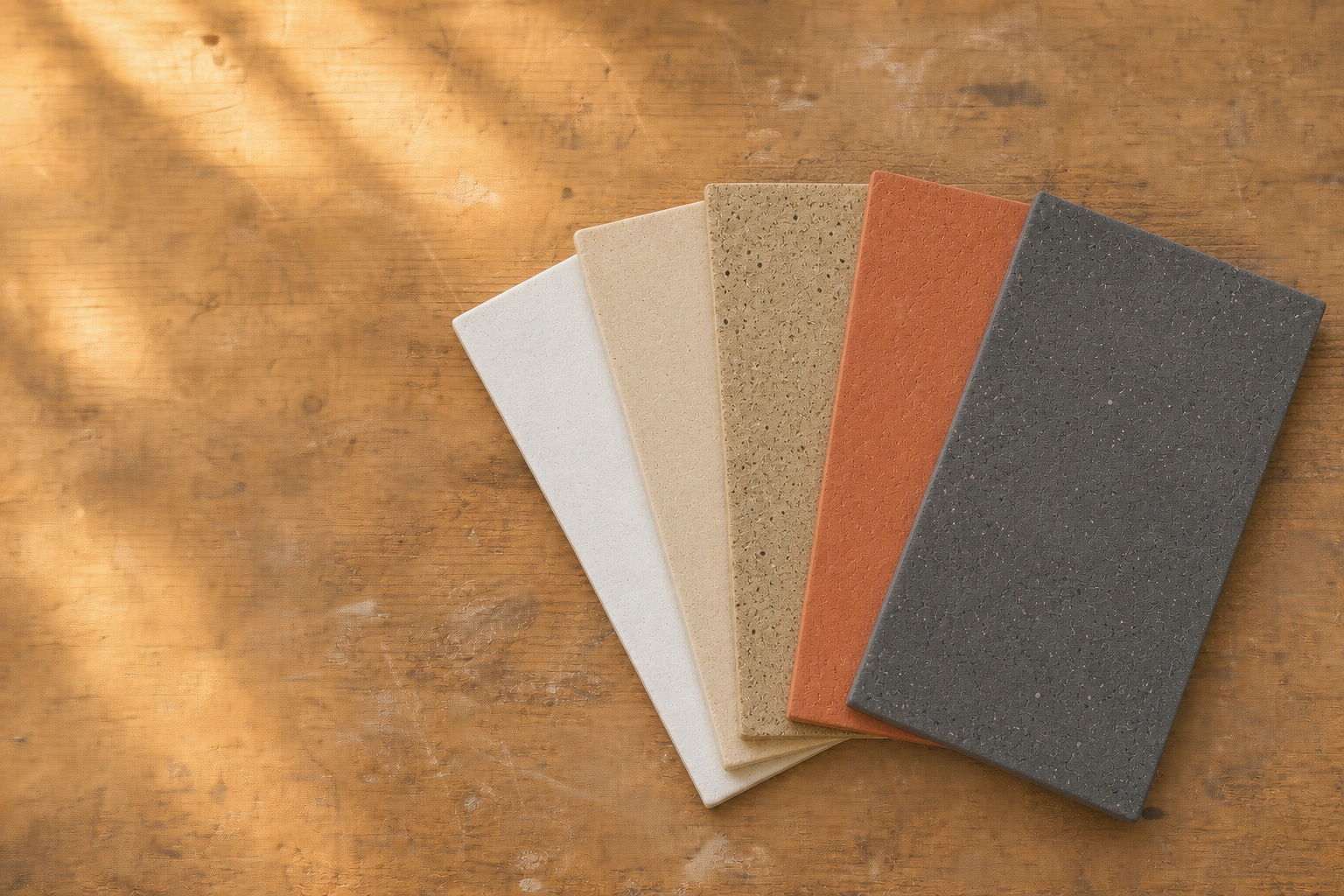
The lease is signed. The architect is finalizing drawings. The contractor has filed for permits. And now every system in the studio needs to be specified — at the same time.
This week, I’m looking at materials — clay and glazes — and equipment, including kilns and wheels. There are many decisions to make. Some have long-term implications; others we can revisit as the studio evolves. This is what building a studio actually feels like: not a neat sequence of milestones, but a tangle of interdependent choices that all need to move forward together.
I’m not going to pretend we have all the answers yet. It’s too early for that. What we do have is a framework for thinking through each one.
Which clay goes on the shelf?
There are dozens of cone 6 clay bodies on the market. Every supplier has a catalog full of whites, browns, buffs, speckled bodies, porcelains, and sculpture clays. Picking "a few good ones" sounds simple until you realize that every choice creates consequences downstream.
A teaching studio has to balance two very different sets of needs.
For students — especially beginners on the wheel — you want bodies that are forgiving. Plastic enough to center easily. Strong enough to hold a wall. Smooth enough that a first cylinder doesn't feel like wrestling sandpaper. A clean white stoneware, a warm brown, and a porcelain that won't punish every mistake — that's a starting lineup that gives new makers a real range to work with without overwhelming them. The wrong clay body can make a first-time potter feel like they don't have what it takes, and that's the last thing you want in a teaching studio.
For experienced members, the clay bodies need to go further along two dimensions: aesthetic and functional. A dark chocolate body that transforms under a clear glaze. A red clay that brings warmth and earthiness. A groggy clay that supports sculptural work over a period of weeks. These are clays that reward potters who already know what they want and can handle the interaction between body and glaze.
But the visible selection is only half the picture. Behind the shelf, the studio has to think about what happens to the clay that doesn't become a finished pot. In a shared studio, scrap clay from every wheel and every table goes into the reclaim system. If you stock six bodies that don't play well together — different shrinkage rates, incompatible chemistries — the reclaim stream becomes unusable. The bodies you choose have to work as a system, not just as individual options.
We're evaluating clay bodies from four different suppliers right now, comparing not just color and feel but shrinkage, absorption, food safety, pricing at volume, and whether they can be reliably sourced month after month. More on that as the picture comes together.
What wheels do we put in the studio?
Our plan has been to equip the studio with Brent CXC wheels — the industry workhorse, the wheel most students learn on, the one you'll find in university ceramics programs across the country. My own wheel is a Brent CXC, and I'm really partial to this make. But there are other great wheels that are significantly lighter, less expensive, and reportedly trouble-free after years of daily use.
This is the kind of thing that sounds like a small detail but isn't. The wheels are the most-touched piece of equipment in the studio. They're what every student sits at on day one. They affect how we teach, how we maintain the space, and how we manage the budget. Lighter wheels are easier to rearrange for workshops and events. Less expensive wheels mean more of them for the same investment. But standardizing on a single brand simplifies maintenance, parts, and muscle memory for members who move between stations.
We haven't decided yet. If you are particularly partial to a particular brand or model, I'd genuinely like to hear it.
The framework behind the choices
Every visible thing in a ceramics studio — the clay on the shelf, the wheel you sit at, the glaze you dip into — has an invisible architecture behind it. Equipment has lead times measured in weeks. Choosing clay means balancing beginner accessibility with the range experienced makers need. Glazes have to be broadly versatile, colorful, and textural while also being sustainable formulations that we can mix reliably and source consistently.
And beyond what members see and touch, the studio has to think about supply chain resilience, cost management at scale, and building relationships with suppliers who will be responsive partners over years — not just for the opening order.
We don't have all the answers yet. We're building the framework to find them. And we'll keep sharing the process here — the tradeoffs, the surprises, and the decisions as they land.
If you're a potter with experience using any of these clay bodies, or if you have thoughts on studio equipment, we'd like to hear from you. This studio is being built for its community, and community input matters — especially now, while the decisions are still being made.
Current stage: materials and equipment specification
Follow the build
Firebox Pottery Studio opens Fall 2026 in Belmont, MA. Memberships, classes, and workshops for every level.
Join the Interest List