Firebox is more than a studio
9 Lexington Street, Belmont. Opening Fall 2026.
Why Clay
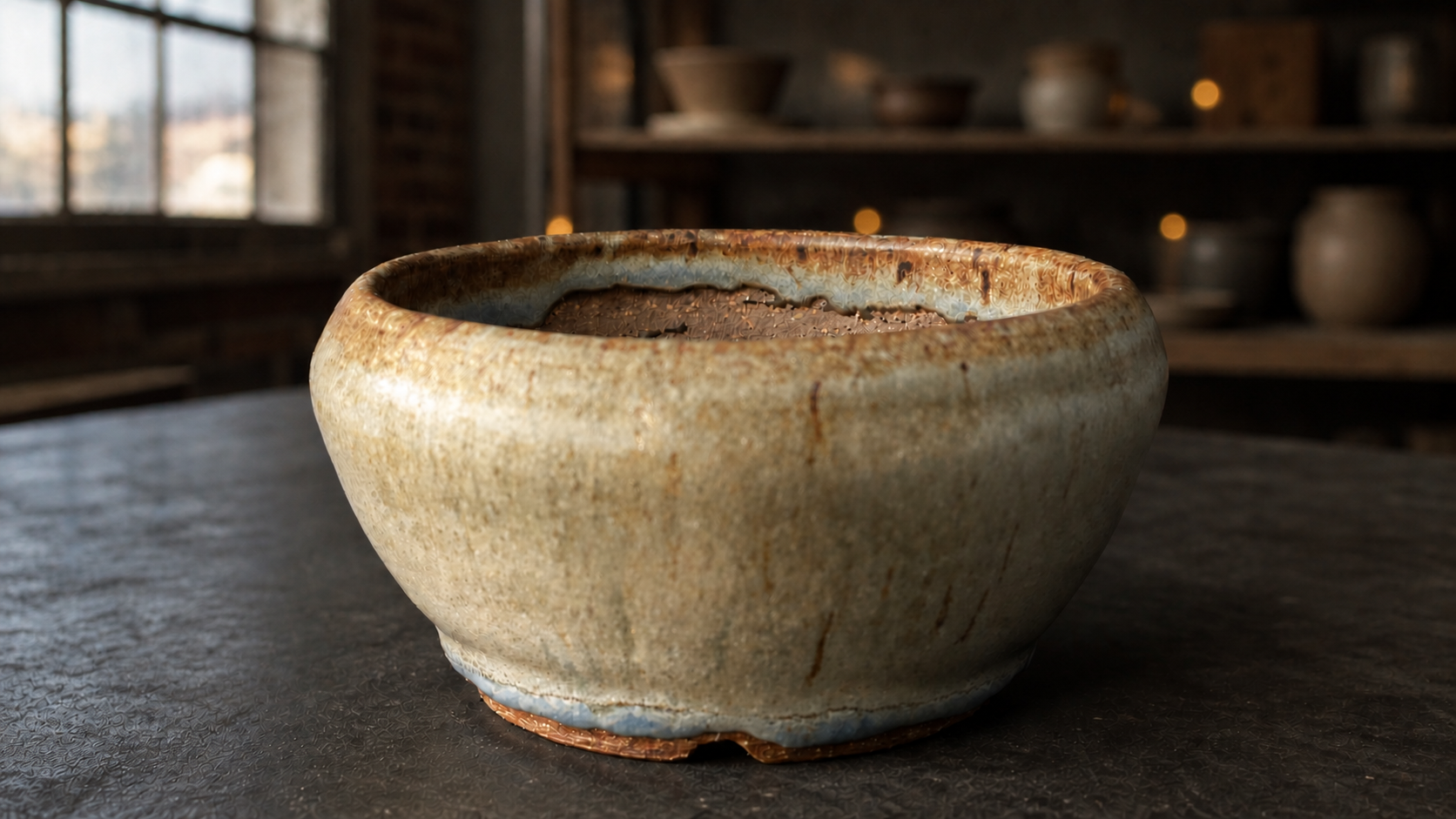
If you're like me, then throwing a pot is an extremely non-intuitive and frustrating process - at least at the beginning. When I was first learning to throw, my ambitions were quite modest. At the end of my first 3 weeks of throwing, all I had to show was a piece I could only call a "cat dish" - a testament to my inability to pull a wall taller than an inch!
But here's the thing, working with clay was sufficiently frustratingly difficult that it kept me motivated to keep going until I could throw a respectable pot. I wanted to get better. I wanted to make something that looked like a pot, and I wanted to make it with my own hands. Coming from a day job that mostly required me to think all the time, I was weirdly, quite proud of the fact that I had made this cat dish which would now, and forever, be part of the fossil record.
For me, throwing a pot takes all my attention. The process of throwing is a practice in patience, focus, and coordination. It is a physical and mental challenge that requires you to be present in the moment. There is a moment in the throwing process that I know things are going to go well. I live for that moment. And where I am in the development of my throwing skills, I'm happy if that moment happens more than once in a session.
And to that extent, for me, throwing a pot is therapeutic. It forces me to think and only be in the moment. To feel how the clay moves and responds to the pressure applied by my hands. In a world where we are constantly bombarded with information, notifications, and distractions, throwing a pot is a rare opportunity to disconnect from the digital world and reconnect with the physical world. It is a reminder that there is value in slowing down, in being present, and in creating something tangible with your own hands.
Firebox is designed to be a place where people can come and experience the joy of working with clay, and to help them develop their skills and confidence as ceramicists. We want to create a community of makers who are passionate about ceramics and who support each other in their creative journeys. There are plenty of great studios out there, but my vision for Firebox is to create a space that is more than just a studio - it is a place where people can come together to learn, grow, and create. A place where they can find inspiration, support, and encouragement from their peers and mentors. A place where they can develop their skills and confidence as ceramicists, and where they can share their work with the world.
An Ecosystem, Not Just a Studio
Most ceramics studios offer one thing — classes, or open studio, or kiln rental. You take a course, it ends, and then you are on your own. Maybe you find another class somewhere else, or you buy a wheel for your basement, or you just stop. The path from "I tried pottery once" to "I have a sustained practice" is full of gaps, and most studios are not designed to bridge them.
Firebox is designed differently. We are building an ecosystem where every stage of a ceramicist's development has a place.
Classes are the entry point. Twelve-week semesters and six-week intensives, small cohorts, real instruction. You learn to throw, to handbuild, to glaze, to understand the full process from wet clay to finished piece. But the goal is not to keep you in classes forever. The goal is to make you independent, and that means our programming is structured to offer classes at various levels and times.
Membership is where independence lives. Twenty-four-hour access to a dedicated workspace, professional equipment, expanded materials, and the freedom to develop your own practice on your own schedule. You are not waiting for a class to start. You are making work.
The gallery gives your work a public life. Display it, sell it, put it in front of people who have never been inside a studio. The gallery sits at the entrance of the building — it is the first thing visitors see, and for some of them, it will be the reason they walk through the door and sign up for a class of their own.
Teaching completes the circle. Members who develop expertise in specific techniques can apply to teach paid intensives and workshops at Firebox. The student becomes the practitioner becomes the teacher. That is not a marketing line — it is how craft traditions have always worked, and it is the culture we are building. At Firebox, we want to enable your growth as a maker, and that includes the chance to teach others what you have learned.
Events and workshops keep the studio open to the broader community. One-off experiences, private gatherings, visiting artists. Not everyone wants a twelve-week commitment, and the studio should be accessible to people at different levels of curiosity and commitment.
Where Ceramics Is Going
Ceramics is one of the oldest human technologies. It is also one of the most active frontiers in digital fabrication. 3D ceramic printers can now produce forms that no human hand could throw — parametric geometries, repeatable prototypes, structures that blur the line between craft and computational design.
Firebox is interested in that intersection. As we grow, we plan to bring 3D ceramic printing into the studio — not to replace handwork, but to expand what is possible. Indeed some forms can only be produced with the help of a 3D printer. A potter who understands both the wheel and the printer has a creative range that neither tool offers alone. A designer who can sketch a form digitally and then fire it in a kiln is working in a space that barely existed five years ago.
This is not a launch feature. It is a direction — a signal that Firebox is being built for where ceramics is going, not just where it has been.
The Space
All of this needs a physical home, and the space has to be designed to support every part of the ecosystem — not just the wheel-throwing.
At 9 Lexington Street in Waverley Square, Firebox occupies approximately 3,800 square feet organized into four studios, a dedicated kiln room, clay and reclaim storage, a gallery, and administrative space. Studio A holds 11 wheels for classes and member overflow. Studio B handles additional classes and member use. Studio C is the handbuilding and events room. Studio D is the dedicated member workspace — six wheels, a slab roller, handbuilding surfaces, and 24/7 access.
The layout follows the lifecycle of the work: clay enters from storage, moves to the making studios, dries on shelves, stages for firing, gets fired in the kiln room at the back, and arrives as a finished piece in the gallery at the front. Kilns, ventilation, and heavy materials are separated from the workspace. Clean and dirty processes stay apart. The building was designed for offices, but we have reorganized it around how clay actually moves.
The Location
Waverley Square sits at the intersection of Belmont, Watertown, and Waltham, a few blocks from the 73 bus line and a short walk from Waverley commuter rail. There is street parking and a small lot. The neighborhood is residential, walkable, and quiet — the kind of place where a gallery at the entrance of a ceramics studio actually gets foot traffic.
Accessibility matters. A studio that is difficult to get to becomes a studio that people stop going to. We wanted a location where members could come before work, after dinner, on a Saturday morning — where the studio fits into daily life rather than requiring a special trip.
The People
Equipment and square footage create capacity. People create culture. Firebox is being designed for a community of makers who want modern facilities to enable their ceramic practice - showing up, cleaning up, respecting shared resources, and pushing each other to get better.
Monthly potlucks. Gallery openings. Studio sales. The chance to teach, to sell, to show your work in a space that treats ceramics as something worth looking at. That is what we are building — not just a place to make pots, but a place where making pots is part of something larger.
Studio principle: A ceramics studio is more than a workspace — it is an ecosystem. Classes create foundation. Membership creates independence. The gallery creates a public life for the work. Teaching closes the loop. The space, the equipment, and the community are all part of the same system.
Current stage: buildout
Follow the Build
Firebox Pottery Studio opens Fall 2026 at 9 Lexington Street in Belmont, MA. Applications for membership and class interest are open.
9 Lexington Street · Belmont, MA 02478
hello@fireboxpotterystudio.com · 617-658-3231